
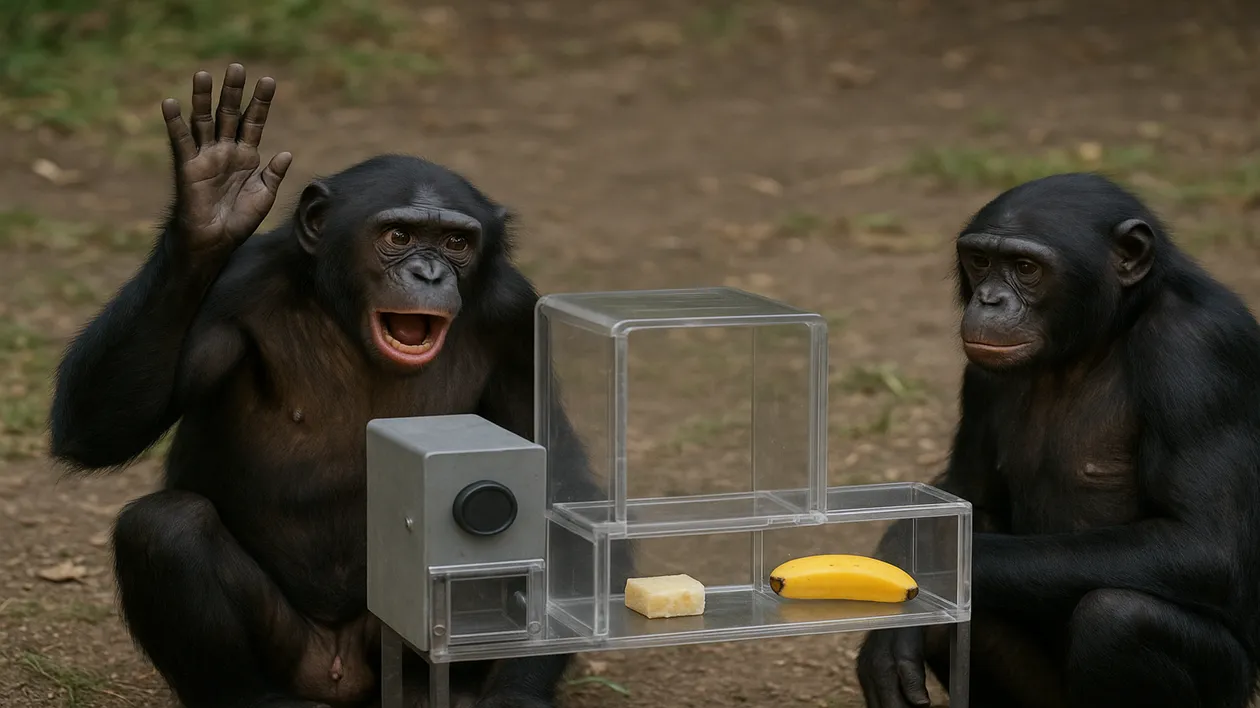
Source: Kia Radovanović et al., “Bonobos respond aversively to unequal reward distributions,” Proceedings of the Royal Society B (16 April 2025).
Inequity aversion in primates — the tendency to reject a raw deal — is one of the most debated windows onto the evolution of fairness. A 2025 study of bonobos strengthens the case that our close relatives notice unfair outcomes. For UPSC Anthropology Paper 1, it is a precise example of primate cognition, cooperation and the deep roots of moral behaviour.
Why this matters: it suggests that sensitivity to unfairness may have evolved as a mechanism that stabilises cooperation, not as a uniquely human trait.
Syllabus relevance: Anthropology Paper 1 — Primate behaviour and cognition; cooperation and social organisation; primatology.
Best use in answers: pair it with the classic capuchin study to trace the evolutionary roots of fairness and cooperation.
What the study actually found
Working with six bonobos at the Wolfgang Köhler Primate Research Center in Leipzig, Radovanović and colleagues used two established tasks: a token-exchange task and a social-disappointment control. Bonobos exchanged tokens for food while a partner sometimes received a better reward for the same effort. Across both studies, disadvantaged bonobos refused to participate more often — an aversive response to inequity.

Why the control task matters
The clever part is the control. In chimpanzees, refusals can sometimes be explained by social disappointment — frustration with the human handing out rewards rather than with the unfair split itself. In bonobos, however, the aversive response could not be explained away by social disappointment. Therefore the reaction looks more like a genuine sensitivity to unfair outcomes.
Concept: inequity aversion
Inequity aversion is the tendency to respond negatively to unequal outcomes. It was first shown vividly in the Brosnan & de Waal (2003) capuchin-monkey experiment, where a monkey rejected a cucumber slice after seeing a partner receive a grape for the same task.
A note on the earlier reporting
Some early summaries framed this as bonobos refusing “most when a machine was involved.” The published study is clearer: bonobos responded aversively to unequal distributions in general, and, unlike chimpanzees, that response was not merely social disappointment with a human partner. The corrected framing keeps the science accurate.
Why it matters for Anthropology
For anthropology, the study feeds directly into questions about the evolution of cooperation and morality. If a sense of fairness has roots we share with bonobos, then human notions of justice may build on an ancient cognitive foundation. In answer writing, that is a strong, evidence-based line.
Use in answer writing: use bonobo inequity aversion, alongside the capuchin study, to argue that cooperation and fairness have deep primate roots.
Paper 1 link: Primate behaviour and cognition; cooperation and social organisation; primatology and comparative method.
Also read
• Orangutans & Metabolic Flexibility
• Anthropology PYQ Analysis
• Anthropology Optional Syllabus Explained
FAQ
What is inequity aversion in one line? A negative reaction to unfair or unequal outcomes, even at a personal cost.
How are bonobos different from chimpanzees here? In bonobos, the aversive response to inequity was not explained by social disappointment with a human partner, unlike in chimpanzees.
Strengthening your primate cognition notes?
Cooperation and fairness are recurring Paper 1 themes. Our complete Anthropology Optional guide shows how to structure such answers. Mentored by Vaid Sir; Anthropology specialists since 1985.
References
Radovanović, K. et al. (2025). Proceedings of the Royal Society B. Brosnan, S. F. & de Waal, F. B. M. (2003), Nature.