
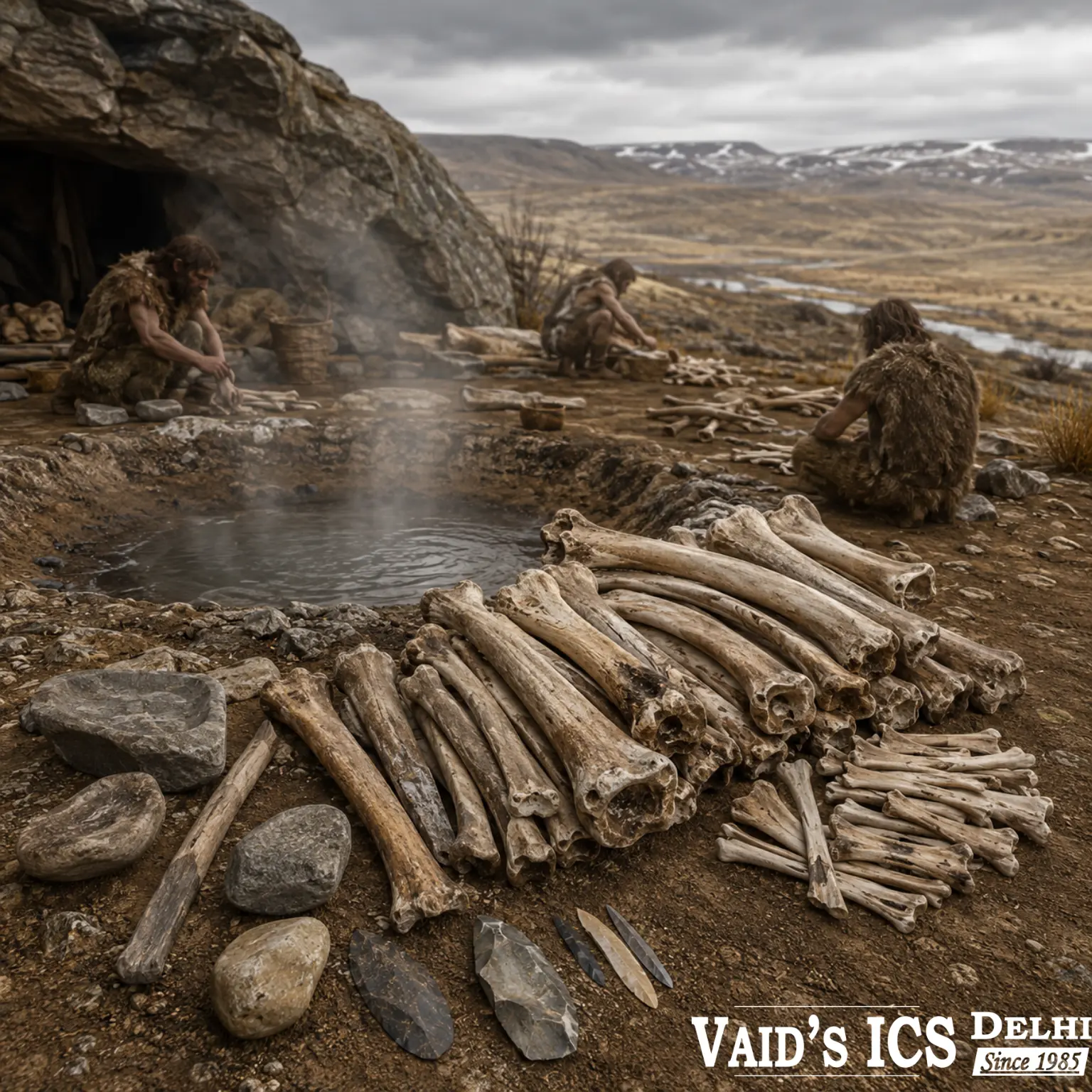
Source: Kindler et al., Science Advances (2025); site of Neumark-Nord, Germany.
Neanderthal resource management has become a powerful counter-example to the old idea of Neanderthals as simple brutes. In addition, at Neumark-Nord in Germany, archaeologists found evidence of a large-scale bone-grease “fat factory” dating to around 125,000 years ago — pointing to planning, foresight and organised subsistence. Moreover, it is an excellent Paper 1 example of Neanderthal cognition and behaviour.
Why this matters: it shows organised, forward-planned food processing far earlier than once assumed, revising views of Neanderthal cognition.
Syllabus relevance: Anthropology Paper 1 — Neanderthals, subsistence strategies, and archaeological evidence of behaviour.
Best use in answers: use it as a case of planning, delayed gratification and resource management in a non-sapiens hominin.
What excavators found at Neumark-Nord
Specifically, excavations uncovered large caches of animal bones — mainly from big herbivores — that Neanderthals had deliberately smashed into small fragments. Furthermore, Neanderthals likely heated these in water for hours to skim fat from the surface. In particular, this bone-grease rendering is labour-intensive and points to a dedicated processing area — a “fat factory.”

Forward planning and foresight
Crucially, Neanderthals appear not to have processed the bones immediately after the hunt. Instead, Neanderthals stockpiled them and later transported them to a single processing site. Similarly, this implies:
- Planning ability across time and space.
- Resource management and division of labour.
- A form of delayed gratification once thought to be uniquely modern.
Nutritional strategy
In fact, bone grease is energy-dense and would have been valuable in cold European environments where plant foods were scarce for parts of the year. Extracting it shows an understanding of nutritional needs and the ability to adapt subsistence to seasonal stress.
Anthropological perspective: Neanderthal resource management
As a result, the finding fits classic frameworks:
- Behavioural / processual archaeology (Lewis Binford): subsistence and tool-use patterns reflect social organisation and cognitive planning.
- Cultural ecology (Julian Steward): groups adapt their behaviour to maximise efficiency in specific environments — here, extracting maximum calories from carcasses.
Together they frame the “fat factory” as evidence of adaptive, planned behaviour rather than opportunistic survival.
Why this matters for UPSC Anthropology
Notably, it supports Paper 1 answers on Neanderthal culture, subsistence and cognition — map it to the Paper 1 human-evolution syllabus, and read it with our note on Neanderthal symbolic behaviour. See the complete optional guide for answer strategy.
Use in Answer Writing
Syllabus topic: Neanderthals — subsistence, culture and cognition (Paper 1).
Key concepts to apply: Planned resource management; bone-grease rendering; Binford (behavioural archaeology); Steward (cultural ecology); delayed gratification.
How to use it in answers: cite Neumark-Nord to argue that complex, planned subsistence predates modern humans, revising Neanderthal cognition.
Concepts to apply in answers
- Planned resource management and delayed gratification
- Behavioural archaeology (Lewis Binford)
- Cultural ecology and adaptation (Julian Steward)
\n
\n
FAQ
What is a Neanderthal ‘fat factory’?
A dedicated site where Neanderthals processed animal bones on a large scale to extract energy-rich bone grease.
Why is it significant?
Stockpiling and organised processing imply planning and resource management once thought unique to modern humans.
Where is this useful in the syllabus?
Paper 1 — Neanderthal subsistence, culture and cognition.
Preparing Anthropology Optional for UPSC?
Turn discoveries like this into sharp Paper 1 answers on human evolution with VAID SIR at VAID’S ICS.
Explore the Anthropology Optional programme →
VAID’S ICS has mentored Anthropology-optional rankers across years, including AIR 3 (2023) and AIR 1 (2020). See the full results.
Sources
- Kindler et al., large-scale bone-grease processing at Neumark-Nord ~125,000 years ago, Science Advances (2025): science.org