
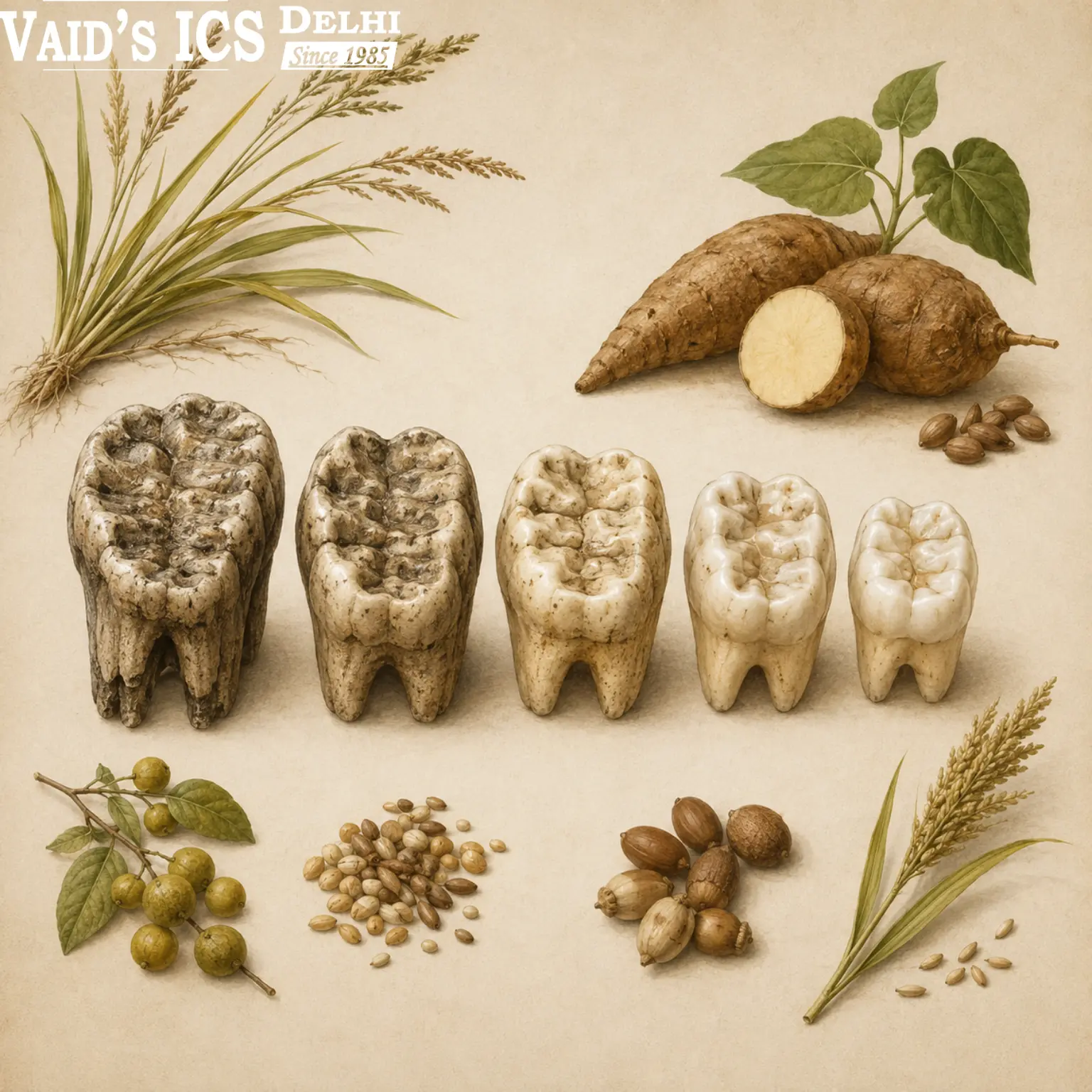
Source: Luke D. Fannin et al., Science (31 July 2025).
The story of diet and human evolution is written most clearly in our teeth. A 2025 study traces how shifts in what our ancestors ate, over almost four million years, forced their molars to change shape. For UPSC Anthropology Paper 1, it is a clean example of how diet, dental morphology and evolution are linked.
Why this matters: it shows diet acting as a driver of dental and, ultimately, wider human evolution — a concrete case of biological adaptation.
Syllabus relevance: Anthropology Paper 1 — human evolution, dietary adaptation and dental morphology.
Best use in answers: use it to argue that diet shaped teeth and helped open the way to later human traits such as larger brains.
Diet is written in the teeth
Teeth preserve well and record diet directly, so they are among the best fossils for studying dietary change. By comparing molar shape and wear across species, researchers can track how eating habits shifted over time.
About 3.8 million years ago: tough plant foods
Australopithecus afarensis was among the first hominins to rely heavily on graminoids — tough grasses and their underground storage organs (tubers, bulbs, corms). These foods were energy-rich but hard to chew.

About 2.3 million years ago: diet outpaced the teeth
By the time of Homo rudolfensis, hominins were regularly eating carbohydrate-rich underground plants — but their molars had not yet adapted to the new menu. In effect, diet was changing faster than the teeth.
About 2 million years ago: early Homo molars adapt
With Homo ergaster, the molars change — becoming smaller and better shaped for grinding softened plant foods. This aligns with an increasing ability to process plant tissues (for example by pounding), and later to cook them. (Firm evidence for the controlled use of fire is clearer only after about one million years ago, so “cooking” at this early stage should be treated cautiously.) Softer, more digestible food meant more available energy — a shift often linked to later brain expansion.
Why this matters
The sequence — afarensis shifting to grasses, rudolfensis relying on underground carbohydrates, ergaster evolving adapted molars as food processing improved — shows diet driving dental evolution, which in turn opened the door to further human change.
Why this matters for UPSC Anthropology
It serves Paper 1 questions on human evolution and biological–cultural interaction — map it to the Paper 1 human-evolution syllabus, and compare the primate angle in our note on primate diet and adaptation. See the complete optional guide for strategy.
Use in Answer Writing
Syllabus topic: Human evolution and dietary adaptation (Paper 1).
Key concepts to apply: Dental morphology; graminoids and underground storage organs; food processing; diet–brain link; biological–cultural synergy.
How to use it in answers: use the afarensis → rudolfensis → ergaster dental sequence to show diet driving evolution, then connect to the biological–cultural synergy PYQ.
Previous Year Questions — UPSC Anthropology
- Critically discuss the synergistic effect of biological and cultural factors in human evolution. (15 Marks, 2024)
- What is the hominization process? Discuss the major trends in human evolution with suitable examples. (20 Marks, 2023)
- Explain the biological changes that made human beings capable of making cultures. (20 Marks, 2018)
\n
\n
FAQ
How does diet shape human evolution?
Dietary shifts changed selection on teeth and digestion; adapted molars and better food processing supported more efficient energy use.
Did early Homo cook food two million years ago?
They increasingly processed plant foods, but firm evidence for controlled fire is clearer only later — so early “cooking” should be stated cautiously.
Where is this useful in the exam?
Paper 1 — human evolution and dietary/dental adaptation.
Preparing Anthropology Optional for UPSC?
Turn dental and dietary evidence into strong Paper 1 answers on human evolution with VAID SIR at VAID’S ICS.
Explore the Anthropology Optional programme →
VAID’S ICS has mentored Anthropology-optional rankers across years, including AIR 3 (2023) and AIR 1 (2020). See the full results.
Sources
- Fannin et al., diet and hominin dental evolution, Science (2025).